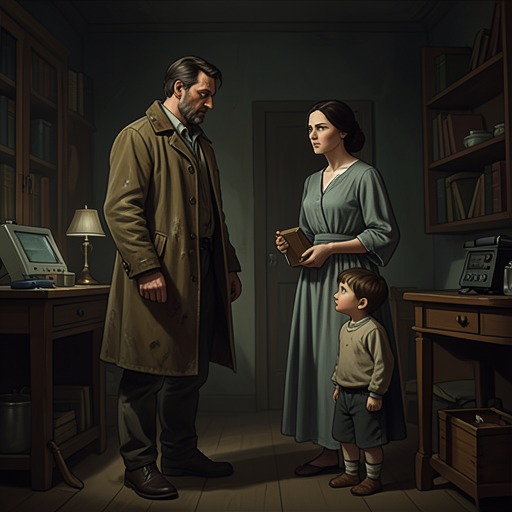
Solitary Confinement and Performative Repentance
David CopperfieldSolitary Confinement and Performative Repentance are joined in the prison system David Copperfield encounters with Thomas Traddles: isolation is presented as a reliable path to reform, while the prisoners’ public displays of penitence expose how easily that claim can become a performance. The visit turns a supposedly self-evident method of discipline into an object of scrutiny. Its grand building and orderly procedures promise moral transformation; its model penitents instead show how institutional approval can reward the appearance of change without establishing that change has occurred.
The System’s Claims
Mr. Creakle, now a magistrate, invites David to see what he calls the only true system of prison discipline. He describes solitary confinement as the sole unchallengeable means of producing sincere, lasting penitents. David accepts the invitation for himself and Thomas Traddles, though the framing is skeptical: before they enter, he remarks on the severity of Mr. Creakle’s concern for convicted prisoners compared with his apparent lack of tenderness toward other people.
The prison gives that claim material form. It is an immense, solid building erected at vast expense. David contrasts its cost with the money that might have gone toward an industrial school for children or a refuge for deserving older people. The comparison sets penal provision against forms of care and prevention, questioning what public priorities the building embodies before its rules are even explained.
Inside, officials describe isolation as the system’s governing principle. Prisoners are supposed to know nothing of one another, and the resulting separation is said to bring them to contrition and repentance. The word system functions as a complete answer: in David’s account, it appears to override doubts and anomalies rather than invite examination of how the method works. That confidence becomes especially questionable when the visitors inspect the prison’s actual routines.
Order, Provision, and the Limits of Isolation
The inspection begins at dinner time in a great kitchen, where each prisoner’s meal is prepared separately to be carried to his cell with clockwork regularity. The food is plentiful and of choice quality. David compares it with the meals available to paupers, soldiers, sailors, labourers, and the broader working population, observing that few among these groups would eat as well. The prison’s order thus coexists with an uncomfortable contrast: people outside its walls who have not been convicted may be materially worse provided for than those held inside.
The officials explain that high living is required by the system, another instance in which the system settles the matter by assertion. Its declared isolation is similarly tested against experience. As David and Thomas Traddles move through the passages and hear about cell visits and the arrangements for chapel, he suspects that prisoners know a great deal about one another and maintain substantial communication. He later says that this suspicion was proved correct. At the time of the tour, however, raising it would have been treated as an attack on the system, so he watches for evidence of repentance instead.
The gap between prescribed separation and actual communication matters because the prison’s claims depend on isolation working as designed. If prisoners can keep in contact, the method is not simply producing solitary reflection; it is operating within a social world that the institution’s public account denies. The tour supplies no demonstration that confinement itself has made the prisoners contrite. Instead, visitors encounter repeated, strikingly similar professions of penitence.
Repentance as a Public Performance
David finds a recognizable fashion in the prisoners’ language, much as there is a recognizable fashion in shop-window clothing. Many make professions that differ little in character or wording. He doubts their sincerity, especially because the prisoners who profess most are the ones who attract the greatest interest. Conceit, vanity, lack of excitement, and a taste for deception may all help explain why a conspicuous display of reform would appeal to them. The institution’s attention therefore risks turning repentance into a rewarded role: the more legible and impressive the display, the more attention it draws.
The tour’s celebrated example is Number Twenty Seven, repeatedly praised as a favourite and model prisoner. David hears of his pious advice to others and the beautiful letters he writes to his mother. Mr. Creakle reserves him for a concluding effect, then peers through the small opening in the cell door and announces that he is reading a hymn book. Visitors crowd around until their heads block the opening. To let them see and speak with the prisoner, Mr. Creakle has the cell unlocked and brings him into the passage. The staged unveiling reveals Uriah Heep, whom David and Thomas Traddles recognize.
Mr. Creakle addresses him with mournful admiration, and Uriah repeatedly describes himself as humble and comfortable in prison, where he sees his former follies. Asked about the beef, he says it was tougher the previous day than he wished, but that he must bear it as his duty. The small complaint is immediately absorbed into the display: he turns a question about food into evidence of meek endurance, and the officials respond approvingly. His language gives the visitors a polished image of submission while leaving the causes and sincerity of his professed change untested.
Two Model Prisoners
The second celebrated inmate, Number Twenty Eight, is Mr. Littimer. He speaks of his past as the result of a thoughtless life serving young men and of weaknesses he lacked the strength to resist. Addressing David as someone who knew him before prison, he warns him to repent of his own wickedness. The speech casts Mr. Littimer as an instructive penitent and David as a former influence who should heed the lesson. The assembled gentlemen respond as if they have witnessed a credible moral transformation.
After Mr. Littimer leaves, a glance between him and Uriah suggests that the two are not entirely unknown to one another and have some means of communication. The detail sits uneasily beside the official ideal of total isolation. Their public conduct also invites comparison: both understand how to speak in the language the observers value, and both are celebrated as exemplary cases. Mr. Littimer’s professions shift attention toward the supposed sins of others, while Uriah uses his performance to reproach David, recalling that David once struck him and declaring that he forgives him. He extends his pity to the Wickfield family and argues that they, too, would be better off imprisoned.
Uriah’s request to write again to his mother further develops the performance. He says he fears she is unsafe, then clarifies that he wishes her to be brought into his state, insisting that prison is better for everyone because sin exists everywhere outside it. Mr. Creakle invites him to affirm that he is changed and would not relapse if released; Uriah readily agrees. The officials receive these declarations with satisfaction, and David and Thomas Traddles leave with relief when Uriah is locked back in his cell. The display has convinced its audience, but not the visitors.
The Critique of Institutional Reform
David’s final judgment is that Uriah and Mr. Littimer are consistent with the people they have always been: their penitence has not changed them. He regards them as precisely the sort of prisoners likely to make such professions in a place where those professions carry value, particularly when they may serve them after they are sent away. The point is not merely that individual prisoners can deceive. The institution helps create the incentive to perform, while its officials’ admiration turns the performance into evidence for the system that solicited it.
Mr. Creakle’s tour has treated the two men’s words as proof of reform, although their conduct gives David reason to doubt them. The prisoners’ reported communication, the crowd’s eagerness to see a hymn-book reader, and the officials’ pleasure in the model penitents all make the prison less a neutral test of inner change than a theatre of approved signs. The system claims to produce sincere penitence, yet the inspection reveals how little its public measures can establish about sincerity.
The novel’s earlier account of Mr. Dick offers a distinct, carefully limited contrast concerning confinement and authority. Betsey Trotwood tells David that Mr. Dick had been called mad and that his brother intended to send him to a private asylum; she intervened, provided for him, and took him into her home. Her account describes protection and companionship in place of the threatened confinement, not a prison reform scheme. Mr. Dick’s later delight in school visits and his extraordinary skill at making objects from simple materials also complicate the assumption that an eccentric person’s abilities can be judged by others’ labels. Set beside the prison episode, this history underscores that institutions and families can wield the power to confine or define another person, while their claims about what is best for that person deserve scrutiny.
David and Thomas Traddles leave the prison unconvinced by its show of success. David hopes that an unsound hobby, ridden hard, may sooner be ridden to death; the image turns the prison’s own insistence into a satirical verdict. The method meant to end doubt instead provokes it, and the model conversions that should vindicate the institution become its most revealing evidence of failure.